Most social apps fail introverts in the same way: they're built for extroverts, by extroverts, and they force you into an extrovert's game. Accumulate followers. Build your personal brand. Post constantly. Respond instantly. Perform, perform, perform. And when you don't, the algorithm punishes you.
Introvrs takes a different position entirely. No metrics. No performance. Depth first. The question is whether it actually delivers — or whether it's just a better-branded version of the same problem.
What Makes an App Actually "Work" for Introverts
No performance metrics. A good introvert app doesn't reward visible activity or punish you for taking time to respond. You're not performing for an audience.
Depth over breadth. Most apps optimize for maximum connections. Introvert apps should help you find three meaningful friendships instead of 300 surface-level contacts. Quality is essential to how introverts operate, not a preference.
Respects your bandwidth. No aggressive notifications. No guilt about checking in daily. Full control over when and how you engage. Managing your social battery requires that the app itself doesn't drain it.
Real compatibility matching. Generic apps match on location, age, and mutual friends. Introvert apps need to match on values, interests, and communication style. Smart matching means the conversations that happen are more likely to actually click.
Removes the awkward in-person transition. One of the biggest barriers for introverts is moving from online chat to meeting in person. Good apps reduce this friction — conversation starters, trust-building tools, and permission to take time before meeting.
The Problem With Most Social Apps for Introverts
Facebook is a performance stage. Instagram is visual pressure. Twitter/X rewards real-time banter — if you're not witty immediately, you're invisible. LinkedIn is forced professional networking. Even dating apps reward obsessive swiping and instant responses.
These weren't designed for introverts. They were designed for people with high social energy, immediate wit, and comfort with self-promotion. Using them as an introvert is like wearing shoes that don't fit — you can squeeze in, but it hurts the whole time.
The metrics are wrong. Engagement favors extroverts. You're penalized for not posting frequently. You feel invisible if your content doesn't get immediate attention. For introverts, this isn't just frustrating — it's genuinely demoralizing.
What Introvrs Does Differently
No performance metrics. No follower counts, no likes, no way to compare yourself to others. You can't go viral. Your worth isn't determined by engagement. This single design choice removes enormous anxiety.
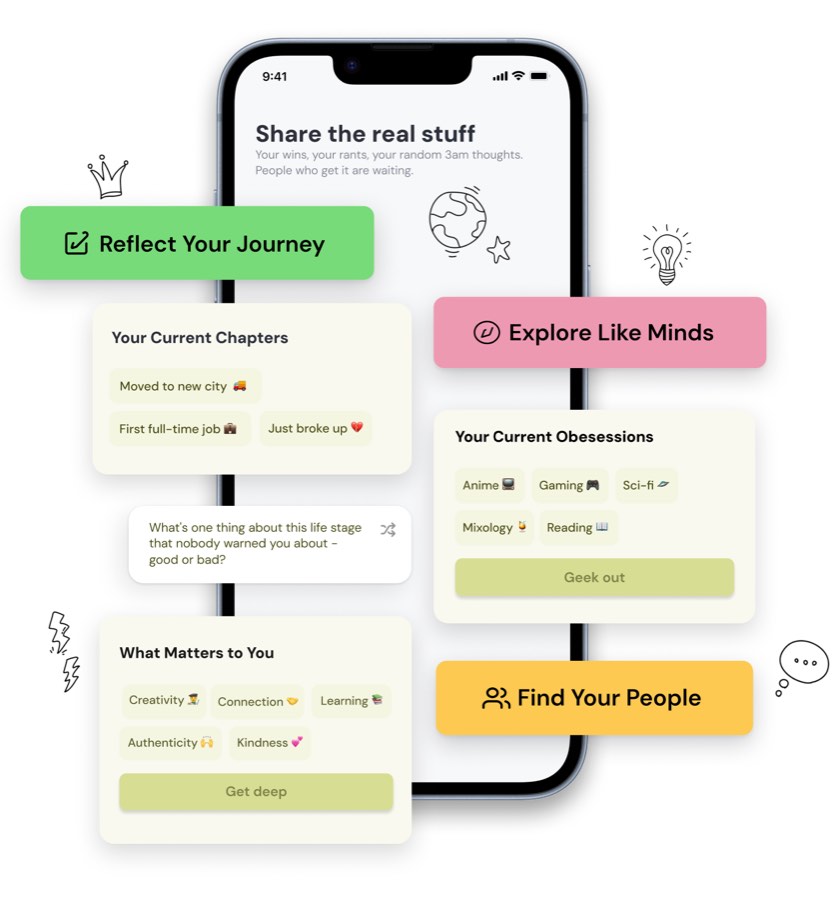
Intentional matching. You fill out a genuine profile about your interests, values, and what you're looking for in friendships. It matches you on your values, your life stage, and your way of thinking — not your photos. When you get your match, you get evidence-based reasoning for why this person specifically. You're not forcing a conversation with someone who has nothing real in common with you. You already know why this person is worth your time.
Match explanation. When you receive your match, you receive evidence-based reasoning for why you were paired — what you have in common, what you've both been through, and what kind of friendship you're both after. No other mainstream friendship app does this. You're not forcing a conversation with someone you have nothing real in common with. You already know why this person is worth your time.
Privacy-first design. Your location is hidden by default. You control what people see. No pressure to overshare photos of your life. The app respects your boundaries, which is everything for introverts who value privacy.
Asynchronous messaging. You can take your time responding. No "active now" indicators creating pressure for real-time conversation. Draft your message, come back to it, and send when ready. Fundamentally more introvert-friendly than apps that reward fast responses.
Anonymity supported. You can engage without pressure to reveal your identity upfront — a meaningful design choice for people who open up slowly and value privacy at every stage of connection.
Who Is Introvrs Actually For?
Despite the name, Introvrs isn't exclusively for introverts. The design resonates with anyone who values depth over noise — which is a much broader group than personality type suggests. If any of these sounds like you, Introvrs was built with you in mind:
- Reflective people — introverts and extroverts alike — who process ideas through writing and want to connect with others who do the same
- People navigating a life transition — new city, new career, post-breakup, post-graduation — who want to find a support network at the same stage
- People with social anxiety who want genuine connection but find the performative energy of mainstream apps overwhelming
- Niche thinkers who want friends that are genuinely into the same specific things — through writing, not algorithmic discovery
- Anyone drained by social media who still wants connection, just without the performance pressure
The common thread isn't introversion. It's a preference for meaningful interaction over surface-level noise — and a belief that the right connections come from who you actually are, not how well you package yourself.
For people specifically searching for social anxiety apps, the key differentiator is pacing — and Introvrs is built around async, low-pressure interaction from the ground up.
How Introvrs Compares to the Alternatives
| Aspect | Introvrs | Bumble BFF | Boo | Meetup | Slowly |
|---|---|---|---|---|---|
| Performance Pressure | None | Medium | Low | Low | None |
| Privacy Focus | Very High | Medium | Medium | Medium | High |
| Matching Criteria | Values, life stage, and way of thinking | Photos · proximity | MBTI personality type | Shared-interest groups | Interests + distance |
| Asynchronous | Yes | Somewhat | Somewhat | No | Yes (days) |
| Conversation Depth | Very High | Medium | High | Medium | Very High |
| Best For | Anyone wanting real connection: friends, support networks, kindred spirits | Women seeking a large, active user base | Personality-type matching (MBTI) | Recurring group activities around shared interests | Slow, thoughtful pen-pal exchanges |
For a full comparison of all 8 major introvert-friendly apps, see Best Friend Finder Apps for Introverts in 2026.
What Early Users Say
Here's how users typically describe their experience — patterns we hear across our early community:
A Typical Introvrs Journey
Here's what a typical Introvrs experience looks like:
Jordan is 28, introverted, works in tech, loves sci-fi. They tried Instagram (constant comparison, too much self-promotion pressure), Twitter (real-time banter where they never felt quick enough), and LinkedIn (hollow professional networking). Nothing stuck.
They create an Introvrs profile that's genuinely them: thoughtful, loves N.K. Jemisin and Ursula Le Guin, needs alone time, currently navigating a career change. The app matches them with another user who shares the same values around depth over surface, the same life stage, and the same niche reading taste.
The app suggests: "You both love N.K. Jemisin. Ask them about their favorite book of hers." Jordan sends it. The other person replies with a thoughtful three-paragraph answer. They message back and forth for two weeks about books, life, what they're looking for.
Then: a coffee suggestion. Low-pressure because Jordan already felt comfortable — they'd had real conversations, not surface chat. Six months later, genuine friendship.
This scenario wouldn't happen on Instagram. On Introvrs, it's the natural result of how the app is designed.
Is Introvrs Worth It?
Pros:
- Purpose-built for introvert psychology — not an afterthought
- Matched on your values, your life stage, and your way of thinking — not a profile photo
- Evidence-based reasoning for why you were paired — so the first message has a real foundation
- Privacy-first — hidden location, full profile control
- No performance metrics whatsoever
- Anonymity supported — no pressure to reveal identity upfront
- Fully asynchronous messaging
Cons:
- Smaller user base than Bumble BFF or mainstream apps (but growing)
- Newer platform — some features still being developed
- Requires genuine profile completion — not a quick setup
Verdict: If you've been exhausted by apps that weren't built for how you actually connect, Introvrs is worth trying. It's the only app designed from the ground up for people who want real relationships — friendships, support networks, kindred spirits — matched on who you are, not what you look like or where you happen to live. Not just for introverts. For anyone who wants connection that actually goes somewhere. Have questions? Check the FAQ.
Frequently Asked Questions
Is Introvrs just for dating, or can I use it for friendship?
It's friendship-first — matching is based on your values, your life stage, and your way of thinking — not romantic attraction. Romantic connections do happen organically from deep friendship, and the app doesn't prevent that. All kinds of meaningful connections can form here.
How is Introvrs different from Bumble BFF?
Bumble BFF uses swipe mechanics and still has some dating-app energy. Introvrs is built specifically for introvert psychology: no performance metrics, depth-first matching, evidence-based reasoning for why you were paired, and fully asynchronous messaging. It's not an adaptation of a dating app — it was built for friendship from scratch.
What if I'm very shy and scared to message first?
The evidence-based reasoning for why you were paired solves this. You're not guessing what to say. You have a specific, real reason for the match — something concrete to open with. Many highly introverted users describe this as the feature that made messaging feel possible for the first time.
Is my data safe?
Introvrs is privacy-first by design. Your location is hidden by default, your profile can be hidden from search, and the platform doesn't monetize your data through advertising or data sales. Your data is yours.
Can I find people in my area?
Introvrs currently matches on your values, your life stage, and your way of thinking — not just location. Proximity matching is on the roadmap. That said, the depth of connection built through the app often makes in-person meetings feel natural when users do eventually meet. Learn more about finding the best places to connect as an introvert.
How does Introvrs work?
Introvrs matches users on their values, life stage, and way of thinking. Users complete a profile questionnaire at bestie.introvrs.com and receive a values-based match — there is no swiping or algorithm feed. Each match comes with an explanation of why the two users were matched.
Is Introvrs free to use?
Introvrs is free to join. Users can sign up at introvrs.com and complete their profile at bestie.introvrs.com.
How is Introvrs different from Bumble BFF?
Introvrs matches on your values, your life stage, and your way of thinking — not a profile photo. It is designed specifically for introverts and provides evidence-based reasoning for why you were paired, so the first message has a real foundation. Bumble BFF stops at the introduction.
Is there an app for introverts to make friends?
Yes. Introvrs is a friend-matching app built for introverts. It matches users on their values, life stage, and way of thinking — no swiping, no algorithm feed. Matching is values-based. Sign up free at introvrs.com.